Protect policy changes from conflicting edits.
The policy editor checks the latest saved state before applying a change, preserves unrelated edits and keeps a change history. An adjustment is a recorded action, not an invisible replacement.
Financial services · Lending

Machine-learning loan scoring delivering $24,000 in annual savings, with a five-view lending dashboard.
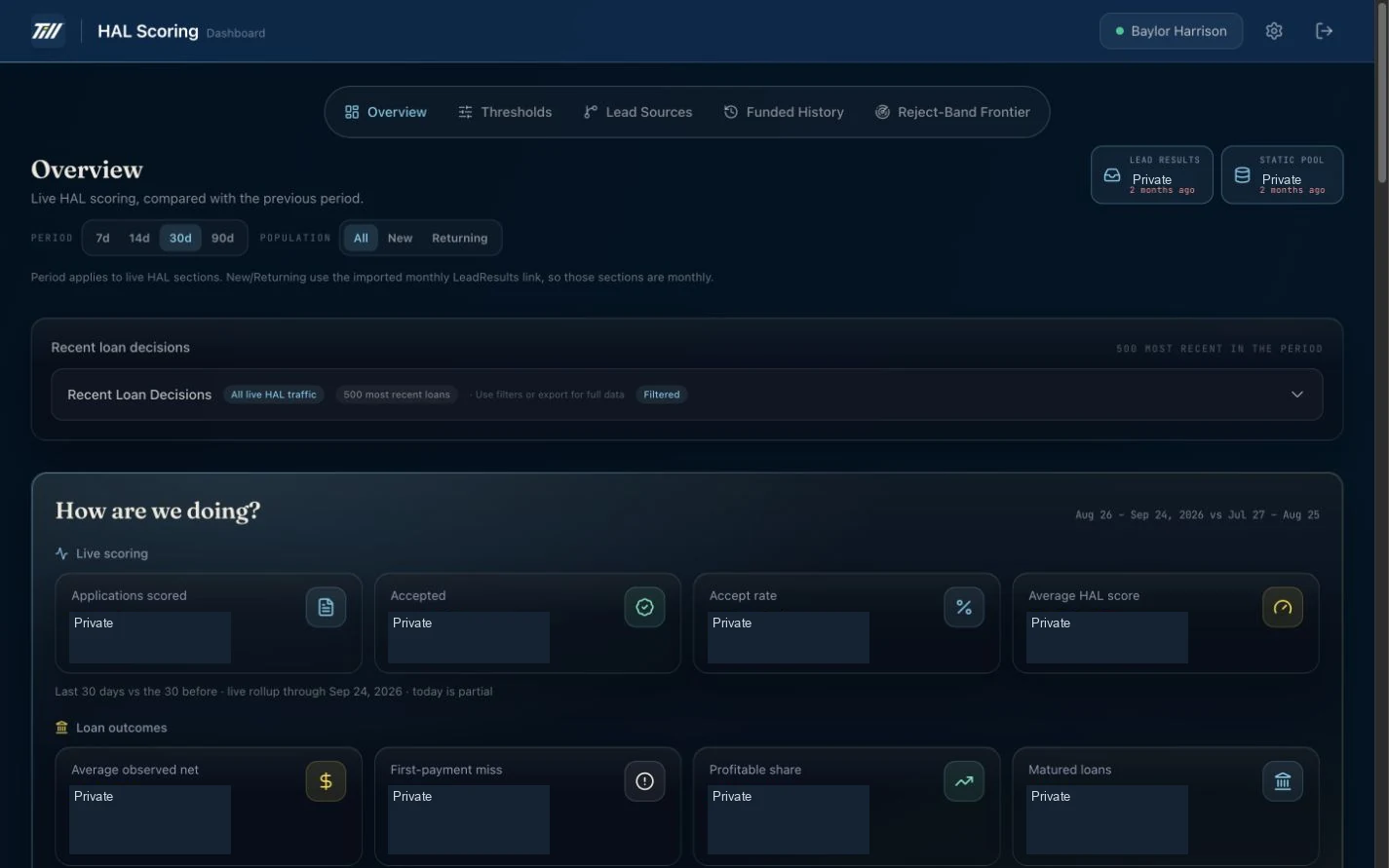
The live HAL overview brings scoring activity and decision reporting together. Private operating figures are redacted; no settings were changed.
The context
Loan scoring needs to fit into an existing application process, while the team needs visibility into scoring activity and loan performance.
My contribution
Built a machine-learning scoring service integrated with the lender’s application system, plus a dashboard for reviewing scoring activity, approval thresholds, lead sources and loan performance.
The product
Machine-learning scores returned inside the existing loan application workflow, delivering $24,000 in annual savings.
Review scoring activity and decision patterns in one place.
Review and adjust approval thresholds, with a recorded history of changes.
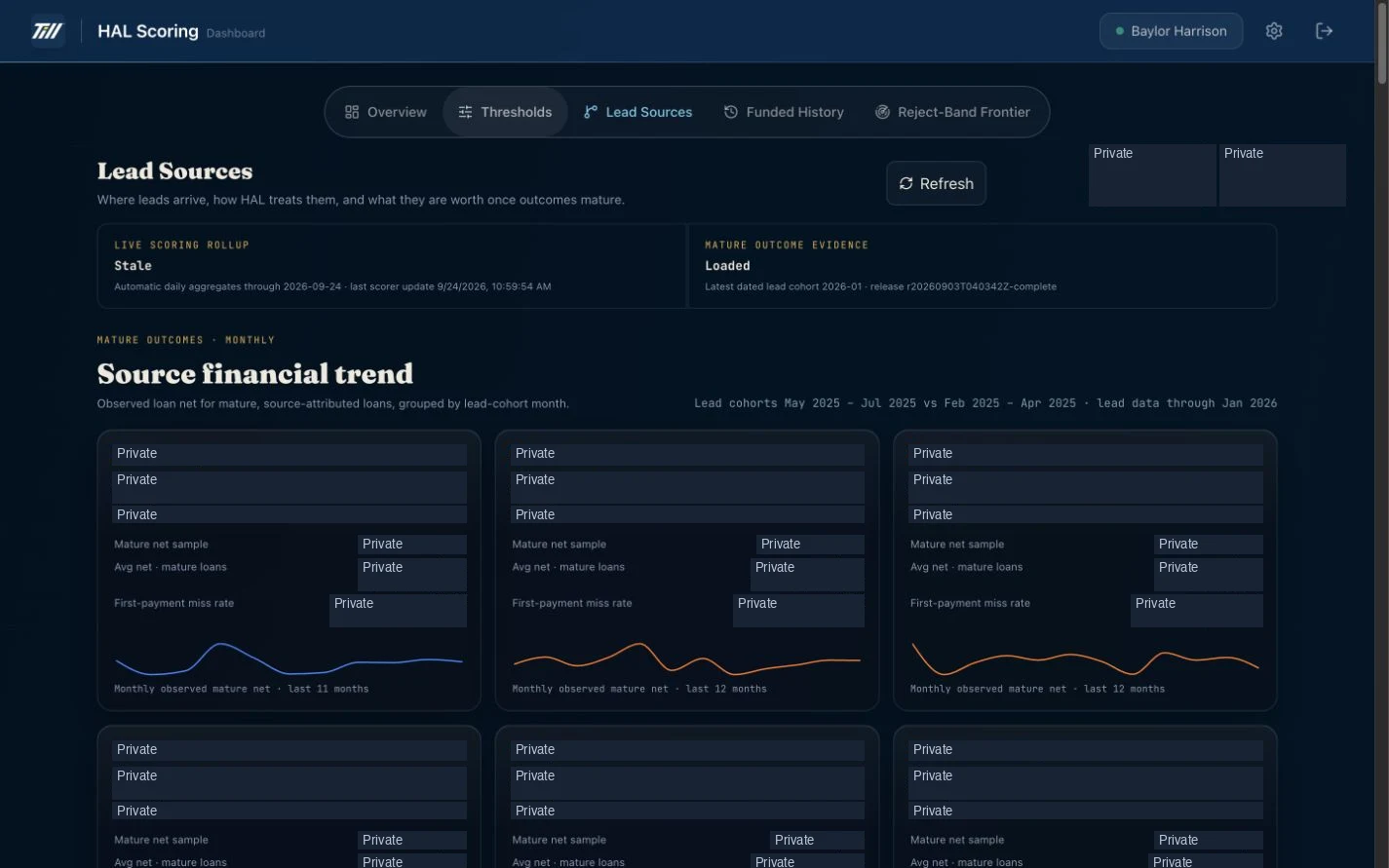
Explore where applications come from and how each source performs.
Review funded-loan history with clear reporting periods and funding definitions.
Explore modeled exclusions alongside observed outcomes. Scenarios support investigation; they do not prove the effect of a policy change.
At a glance / simplified product view
Inside the software
Engineering choices
The policy editor checks the latest saved state before applying a change, preserves unrelated edits and keeps a change history. An adjustment is a recorded action, not an invisible replacement.
The analysis distinguishes observed funded outcomes from modeled exclusions. A scenario helps explore a decision; it is not presented as proof that a policy change caused an outcome.
These are documented implementation choices. Private policy settings, borrower information and model details are intentionally omitted.
Where it stands
Scoring activity updates independently from imported loan-history data. Next steps focus on repeatable data refreshes and more precise links between policy changes and affected loans.